
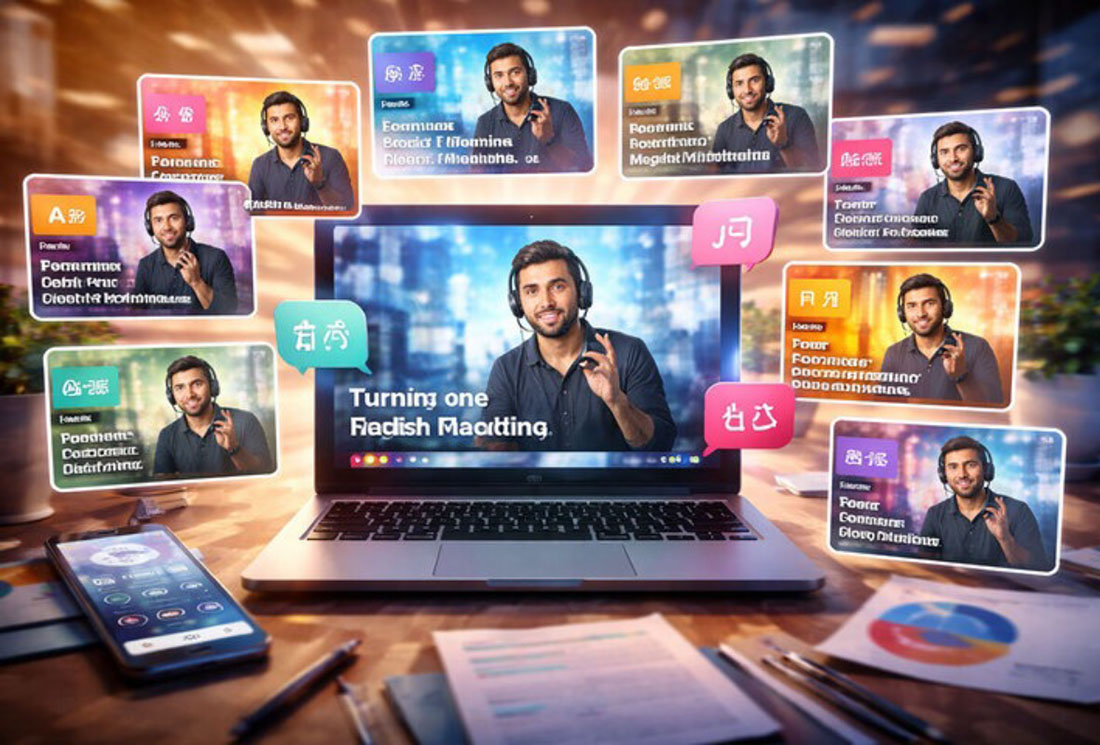
If you’re creating video content in English and wondering why your views don’t scale as they used to, let me let you in on a little secret. Most of the world doesn’t have English as its primary tongue. Although English will be the most spoken language in the world in 2025, with 1.5 billion speakers, only about 25% of those speakers are native speakers. The rest navigate your content around a second or third language.
By keeping your videos monolingual, you are inadvertently restricting your reach to a portion of that global audience. Nowadays, thanks to AI-powered platforms, it’s practical to have your videos in multiple languages to unlock views from audiences who would otherwise just scroll past.
Why Multilingual Video Matters in 2025
Because of technology, the current English-language scenario has transitioned from being English-dominant to English-centric but multilingual. According to recent 2025 linguistic data, native speakers of Spanish (484 million speakers) and Mandarin (990 million speakers) outstrip English speakers by a wide margin. Therefore, it has become a massive untapped market for content creators.
Viewers engage more deeply when watching videos they can understand without straining their brains. When your videos speak directly to a viewer, whether through high-quality dubbing or localized captions, watch times rise, and search visibility improves.
In 2025, videos that have correct multi-language captions or audio are estimated to have an average 40% increase in watch time compared to videos that do not. Of course, beyond the need to translate videos, this is all about accessibility, ensuring every individual viewer feels at home in the video.
The Science of “Native” Connection
Why does a localized video perform so much better than one with auto-generated English subtitles? It all goes back to the affective filter in learning and comprehension. When a viewer is watching content in their native language, their brain is able to process it at a lower cognitive load; hence, their brains are more freed up to focus on the creative nuances of your video, things like your home decor tips or UGC styling.
Plus, Google and YouTube index metadata in many different languages. By translating your title, description, and tags, you’re not only making your video readable, but you’re making it findable in foreign-language search queries. That’s the difference between competing with every English-speaking creator in the UK versus being the only aesthetic home-tour creator coming up in a Spanish-speaking user’s feed.
Scaling English Content into Multilingual Hits
The core strategy for 2025 isn’t to produce ten entirely new videos for different regions. But the strategy is simply to leverage your high-quality English-language content and rely heavily on the technologies available to let them do the heavy lifting. This Master File approach turns one piece of content into a global engine:
● Identify high-performers: Begin with your evergreen videos that appeal to a wide audience (e.g., “5 Ways to Style a Small Living Room”).
● AI transcription & translation: Turn your English speech into a smooth transcript using AI-powered tools, such as Murf.AI.
● Localize for nuance: Instead of translating word by word, it is important to ensure the vibe is captured.
● Audio integration: This is where you use technology to translate video audio into natural-sounding speech.
Tools That Make Global Growth Practical
The key to this workflow’s existence is the automatic translation of the video using AI technology. Dubbing used to require actors’ voices to be recorded in a studio, which would be a cost completely out of reach of independent creators.
Nowadays, tools such as Murf.AI have completely changed this by providing a video translator by means of artificial intelligence. In this way, after uploading your English video, by using this tool, you are able to translate it into more than 20 different languages by applying natural voices.
In these tools, they do not simply read text. Instead, they provide synchronization of the audio of the video to demonstrations so that your 10 multilingual hits can be ready for uploading while drinking a cup of coffee.
Real-World Momentum: The “MrBeast” Effect
That is where all the big players in the game are moving towards. YouTube officially expanded its multilingual audio features in late 2024 and 2025, which allows creators to upload a single video with multiple audio tracks.
Results have been staggering:
● The 25% Increase: According to YouTube, creators who have multilingual audio tracks have more than 25% of their total watch time come from views in a non-primary language of the video.
● The Gen Z appetite: In markets such as India, which is the second fastest-growing group of English speakers in the world, a full 77% of Gen Z viewers are now watching content that was first produced in another language.
● Meta integration: Instagram and Facebook Reels now support AI-powered voice translations into major languages, including Hindi, Portuguese, and Spanish. This even includes lip-syncing tech to help make the translation feel native.
Maximizing Reach Without Reinventing the Wheel
To conclusively prevent leaving views on the table, you must begin to treat your local editions with the same respect that you give to your original English edit.
● Localized metadata: Translate your YouTube video thumbnails. For example, if you use Room Tour for the English thumbnail, Tour de mi habitación will be used for the Spanish translation.
● Regional hashtags: Find out which lifestyle hashtags are currently used in your targeted regions (for example, #decoracion and not #homedecor).
● Community Engagement: Don’t be afraid to use a translation tool to respond to comments in the native language of your viewers. This will allow you to build a dedicated, worldwide fan base.
The Future of Global Content
In the last half of 2025 and through most of 2026, a monolingual creator will become an anomaly. With the advancements of AI translation technology, language frictions will become increasingly irrelevant. Whether a personal influencer, a UGC producer, or a small brand owner, video translation is hands down the most powerful way to extend your reach without extending your efforts.
Don’t let your best work stay trapped in a single language.