
There’s a particular kind of tired that comes with a house that’s almost right, but doesn’t feel finished. Ours was like that for a long time. Nothing was broken exactly, but every room felt a half-step away from finished. And with two boys, a wedding to plan, and a budget that doesn’t stretch to knocking walls down, a proper renovation was never really on the cards.
So I did the only thing I could. I started small. One weekend, one job, one little change at a time. And somewhere along the way the house quietly stopped feeling like a work in progress and started feeling like ours. People come round now and say it looks “expensive,” which always makes me laugh, because most of what we did cost less than a weekly food shop.
If your home feels a bit unfinished but a full renovation feels out of reach, this one is for you. These are the seven changes that genuinely made the biggest difference for us, roughly in the order I’d do them again. None of them needed scaffolding or a skip in the driveway.
1. Start with the thing your hands touch fifty times a day
If you only change one thing, make it the thing you actually use most. For us, that was the kitchen sink. We spend more time at ours than anywhere else in the house, and yet it was a tired, scratched stainless steel thing that I’d stopped noticing years ago.
Swapping it for a proper fireclay farmhouse sink is still the single change people comment on most when they walk into the kitchen. That deep apron front instantly gives the whole room a country-cottage feel, even though the rest of the units are fairly plain. It became the anchor the kitchen was missing.
The practical side surprised me too. Fireclay is genuinely tough, so it has shrugged off everything two small boys can throw at it, from dropped pans to whatever they were “washing up” that afternoon. Ours has a fluted front and a little workstation ledge, so a chopping board and drying rack slot straight across the top, which quietly gave me back a chunk of counter space I didn’t know I was missing. One honest heads-up, because I did my homework before buying. Fireclay is the toughest of the sink materials for chips and stains, but dragging a cast iron pan across it can leave a grey metal mark. The good news is a quick rub with a cream cleaner lifts it straight off, so it’s worth knowing rather than finding out in a panic.
Above: our fluted fireclay farmhouse sink, still the first thing people notice.
2. Turn dead space into the best seat in the house
We had an awkward bay window in the front room that spent years doing nothing but collecting post, odd socks, and the occasional abandoned toy. It bugged me every single day, and yet I never quite knew what to do with it.
The fix turned out to be simple. We built a low bench across the recess (a couple of stock kitchen units and a length of timber, honestly nothing clever) and then topped it with a proper made-to-measure cushion. That one addition changed the whole room. It’s now the spot the boys curl up to read, where I have my first coffee before the house wakes up, and where the light lands so beautifully in the mornings that I keep taking photos of it.
If you’re doing the same, the cushion is where it lives or dies. Have a scroll through the home forums and you’ll see the same story on repeat. One person was quoted well over a thousand pounds for a single bespoke banquette cushion and quite rightly called it madness, while others got stung by delivery fees almost as high as the cushion itself. And the cheap off-the-shelf pads never really solve it. They sit an inch too short, slide about, and look like an afterthought. Having custom cushions for window seats made to the exact size of the bench, in a fabric that ties into the room, is what makes the whole thing look built-in rather than bodged together on a Sunday. Mine wraps right to the edges, so there’s no sad gap at the sides, and the fabric matches the curtains just enough to look intentional. Two things are worth knowing before you order. Go for a 3 to 4 inch thick foam if you actually want to lounge on it, or keep it nearer 2 to 3 inches if it doubles as dining seating. And think hard about the fabric, because a window seat gets blasted with sun. Deep reds and maroons fade the fastest, so a fade-resistant performance fabric saves you re-covering it in a couple of years.
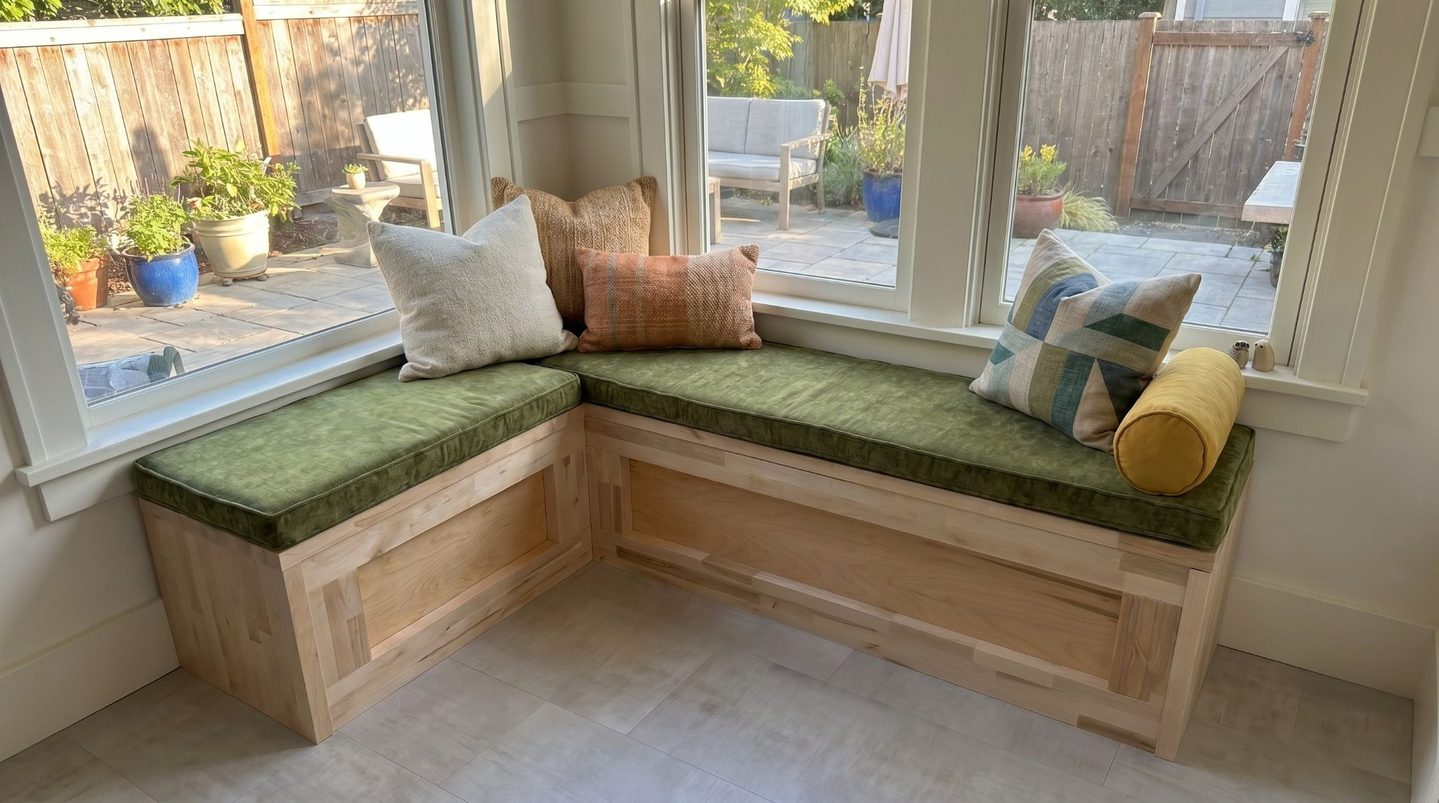
Our bay window seat, and honestly the spot that gets used most now the cushion actually fits.
3. Paint the fifth wall
We forget we have a ceiling until someone paints one properly. Ours were all standard brilliant white, which sounds fine until you realise how cold and flat it makes a room feel.
In the front room I painted the ceiling the same soft off-white as the walls, and in the boys’ room I went a shade further and colour-drenched the whole thing, walls and ceiling in one gentle tone. Both cost a tin of paint and an afternoon, and both made the rooms feel bigger and softer, not smaller. It’s the cheapest “wow” on this list by a mile.
4. Swap the small metal bits
This is the one nobody expects to matter, and it’s the one I’d shout about the most. Builder-grade homes are full of shiny white plastic light switches and flimsy little handles, and your eye clocks them as “cheap” without you ever consciously noticing.
We changed the switch plates in the main rooms to brushed brass, swapped the kitchen cupboard handles for something with a bit of weight, and put proper knobs on the bedroom drawers. Each piece was a few pounds and took minutes to fit with a screwdriver. Together they read as a deliberate design choice rather than whatever the developer had going spare. While you’re at it, add soft-close buffers to the kitchen cupboard doors. They’re about £3 each online and stop that horrible clatter every time someone shuts a door, which somehow makes the whole kitchen feel a lot more expensive. If you want the biggest lift for the least money, start here.
5. Layer the lighting
One big light in the middle of the ceiling flattens a room and makes the evenings feel like a dentist’s waiting room. It took me embarrassingly long to work this out.
Now every room has at least three sources of light. A table lamp, a floor lamp, maybe a little picture light or some fairy lights for the boys, all on warm bulbs rather than that harsh blue-white. Whatever you do, steer clear of the “daylight” or “sunlight” temperature bulbs. As one honest soul online put it, they make your house look like a storage facility. In the evenings I switch the big light off entirely and just use the lamps. The whole house feels calmer and, yes, more expensive, because soft pools of light are exactly what you see in the interiors magazines. Warm bulbs are a couple of pounds and undo years of harsh overhead glare in a single evening.
6. Style with what you already own
You do not need to buy “decor.” I promise. Most of my favourite corners are made entirely of things we already had, just arranged with a bit more care.
A stack of books I actually love, a bowl we brought back from holiday, a trailing plant in a nice pot, grouped together in odd numbers on a shelf or a windowsill. That’s it. It looks more expensive than anything off the shelf precisely because it looks lived in and personal. Before you spend a penny, do a lap of the house with a tray and gather the things you already like, then group them properly. You’ll be surprised how much you own that you’d stopped seeing.
7. Refresh the soft stuff
The textiles are what your eye actually lands on, and they’re the cheapest thing to change with the seasons. Fresh cushion covers, a chunky throw over the arm of the sofa, a proper doormat that isn’t curling up at the corners.
I keep two sets of cushion covers, lighter linens for summer and something warmer and more textured for winter, and swapping them over takes ten minutes and makes the whole room feel new. A good throw hides a tired sofa better than anything, and a decent doormat sets the tone before anyone’s even through the door.
The little things add up
None of this needed scaffolding, a skip, or a builder in the driveway for six weeks. The window seat and the new kitchen sink were the two bigger jobs, and even those were done over a weekend without turning the house upside down. Everything else was a screwdriver, a tin of paint, or an afternoon of moving things I already owned.
If your home feels a bit “unfinished” but a full renovation feels out of reach, that’s honestly the best place to start. Pick the thing you touch most, make it lovely, and let the small changes stack up. A home doesn’t need gutting to feel like yours. It just needs a bit of attention, one weekend at a time.
Hope it gives you a few ideas for your own place. Let me know in the comments which little change you’d start with.