How to Choose a Rose Gold Engagement Ring That Feels Like You
A rose gold ring can look almost peach in one photograph and quite coppery in another. If you keep saving those soft pink designs, it is worth finding out which colour you actually love before choosing one.
The appeal might be a fine blush-coloured band, a warmer frame around a diamond, or the way rose gold looks beside the silver jewellery you already wear. Each gives you a slightly different starting point. Here is how to turn that preference into a ring you enjoy on your own hand.
Start with the shade, not the photograph
Rose gold gets its colour from the metals mixed with gold, particularly copper. It is an alloy, rather than pure gold that happens to be pink. Different mixtures produce different shades, so “rose gold” does not describe one exact colour.
Try a rose gold ring beside yellow gold and a white metal in the same lighting. Look first at the band rather than the centre stone: which colour do you keep coming back to? If rose gold is your favourite, compare two rose gold samples together under the same light to see whether you prefer a softer pink or a more coppery shade.
Lily Arkwright offers its Grace solitaire set with man made diamonds in 18ct rose, yellow and white gold, as well as platinum. Comparing the same design across metals helps you work out whether it is the colour you love or the ring’s shape. Keep the centre-stone dimensions similar when making that comparison.
If you can visit a jeweller, look at the ring in softer daylight as well as under the display lights. A warm photograph or filter can make a subtle pink look much stronger. Use saved pictures to explain the effect you want, then judge the actual metal.
Decide how much rose gold you want to see
A fine band gives you a small line of colour. A broader polished band makes the pink more noticeable, while diamond-set shoulders break it up with sparkle. You might love rose gold in all three forms, but they do quite different things on the hand.
Look around the centre stone too. Rose gold claws bring the warm metal right up to its edge. A white-metal setting on a rose gold band creates a different contrast, with most of the pink sitting further away from the diamond.
GIA explains that a diamond can reflect the colour of its setting. Rose gold can therefore contribute pinkish reflections; it does not turn a colourless diamond into a pink diamond. View the complete ring rather than assuming the stone will look exactly as it did loose or in another setting.
Wear it with the jewellery you already reach for
Take your usual watch or bracelet to a try-on appointment. It is much easier to judge a new metal beside something familiar than to imagine your entire jewellery box from memory.
A silver-toned watch can give a rose gold ring a crisp contrast. A yellow gold bracelet creates a warmer combination, where the difference between the two shades may be subtler. Try both if you wear both.
If you enjoy mixing silver and gold jewellery, rose gold can join that mix. Start with the pieces you normally wear together and add the ring. You can repeat its pink tone in a small detail, such as earrings, if you like a more coordinated look, but there is no need to buy a matching set.
Look at it against your everyday clothes too. A black cuff makes the colour easy to notice; a cream knit gives you a softer backdrop. Those familiar outfits can be more useful than a rule about which skin tone should wear which metal.
Does rose gold fade or need replating?
A ring made from rose gold alloy throughout does not need routine replating to stay pink: the colour comes from the metal itself. It is different from a rose-gold-plated piece, where a surface coating supplies the colour. Check which construction you are buying rather than relying on the colour name alone.
An alloy ring is not immune to wear. Scratches and changes to its surface can alter how it looks over time, even though the pink is not simply a coating wearing off. Ask the jeweller what care and refinishing they recommend for that ring.
Check the gold content as well: 9ct means 37.5% gold, while 18ct means 75%. The remaining metals affect the shade, so the carat number alone is not a reliable colour swatch. If you are choosing between two alloys, see samples rather than assuming one will be the exact pink in your saved photograph.
Choose the wedding band alongside it
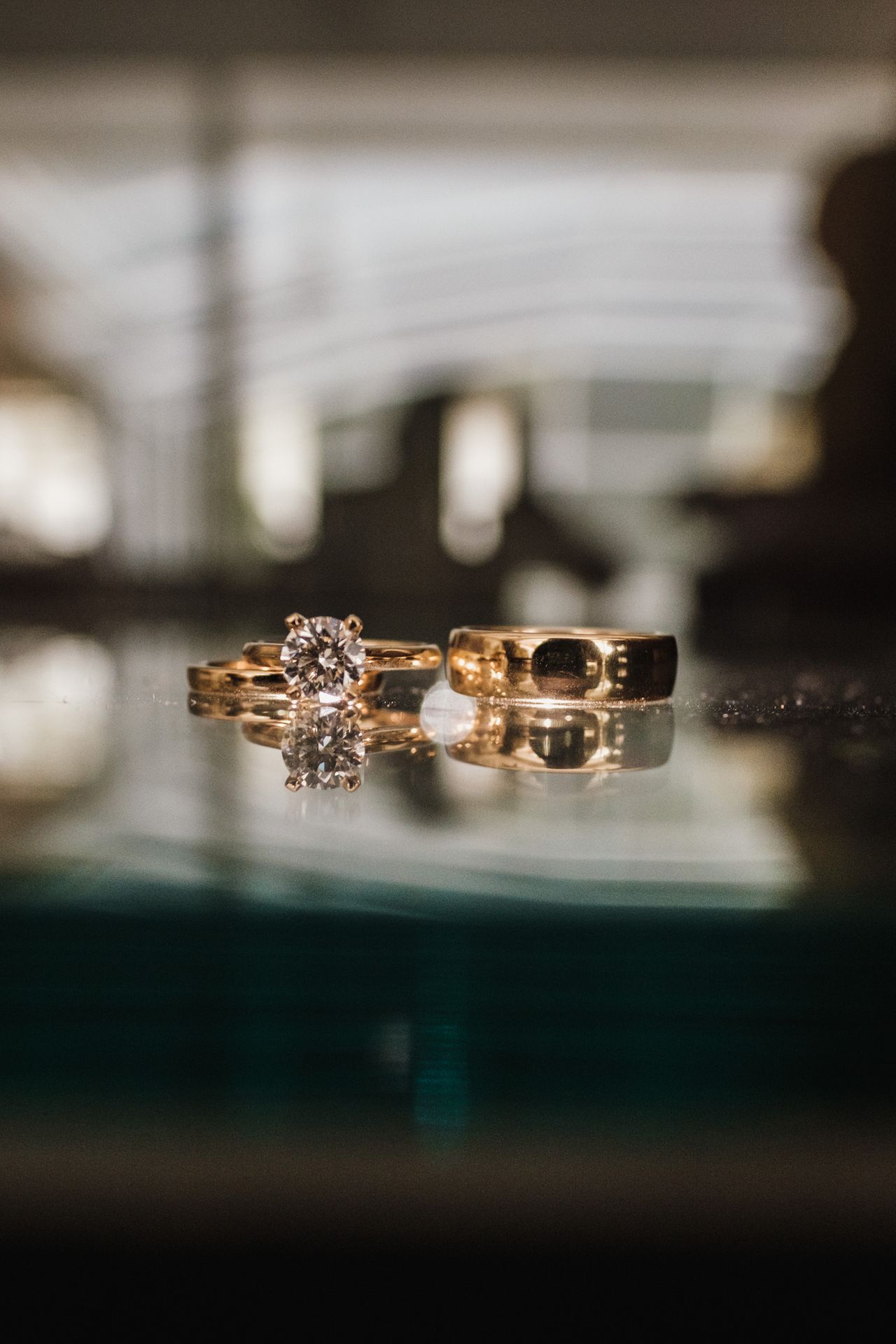
If you want a matching rose gold wedding band, compare the two rings together. Matching colour names, or even matching gold carats, do not guarantee an identical shade from different makers.
You could also choose a different metal deliberately. Try a plain white-metal band beside the engagement ring, then a rose gold one, and notice which makes the combination feel more like yours. Have the jeweller check the fit and contact between them as well as the colour.
There is no need to order both immediately. Seeing the pair gives you a better idea of the ring you will eventually wear. The best result is a shade you still love beside your everyday favourites, not one that only works in the photograph that started the search.